

The best post move is the one your defender gives you. If he plays on your high side, drop step to the baseline. If he plays low, turn to the middle. If you feel no pressure, shoot the jump hook. If he is straight behind you, spin baseline. If he backs off, face up. And if he leaves his feet, go up and under.
That is the core of Chapter 4 in my book Developing Basketball Post Players. Here is each move, the cue that makes it work, and how many your post player really needs.
Which Shots to Look For First
Before the moves, the order. Don Meyer ranked a post player’s shots this way: the shots you get on the break, then a power move with no dribble, then a power move with one dribble, then your go-to move, then your counter.
The move itself depends on the defense. The book borrows a six-word rule from Mark Few at Gonzaga: take what the defense gives you.
Feel Him First
You cannot take what he gives you until you know where he is.
Feel the pressure when the ball reaches your chin. Do not pick your move before you catch. If you do not feel him, slow down and read.
The pass helps too. Guards are taught to pass away from the defense, so a pass to your left or right tells you which side he is on, and a pass to the middle tells you he is right behind you.
He Plays High: The Drop Step Baseline
When your defender plays on your high side, he is guarding the middle. Go the other way. Seal him and take one dribble to the power box, the area right in front of the rim.
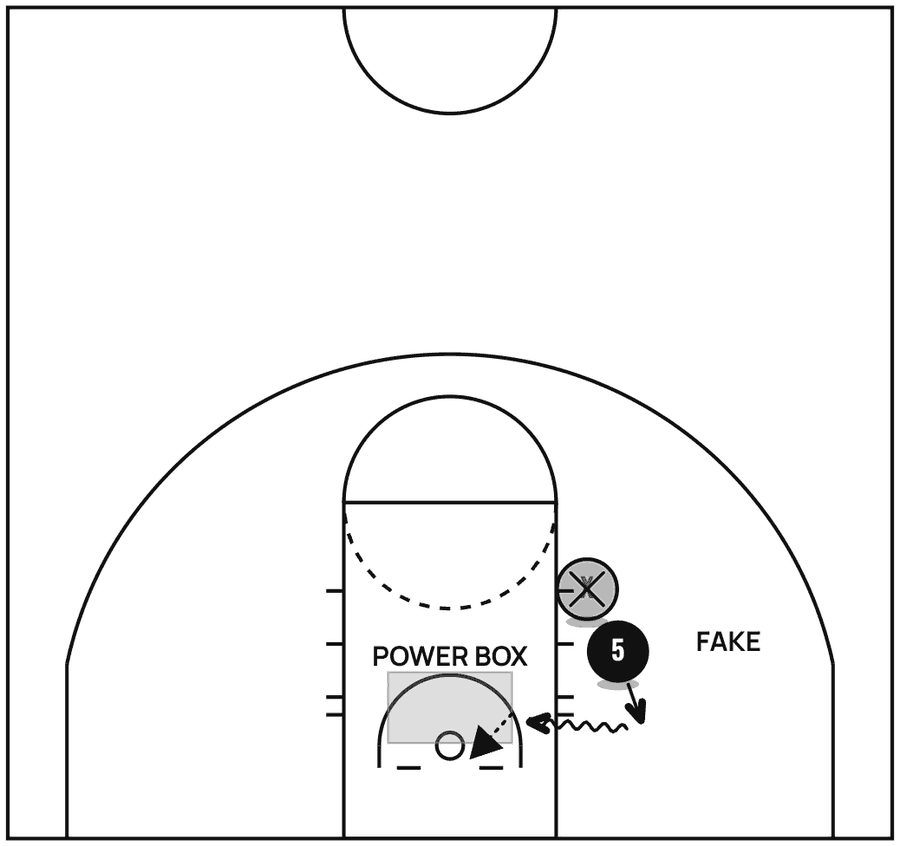 The defender plays high, so the 5 fakes to the middle, drop steps to the baseline, takes one power dribble into the shaded power box and finishes off the glass.
The drop step in five steps:
- Catch. Low and wide on the block, both feet on the floor, the defender on your back.
- Step. A big, quick step with your bottom foot toward the baseline. Your top foot is the pivot.
- Square. Turn your shoulders to the backboard with one power dribble and a step through with your top leg.
- Jump. Go up off two feet and explode at the rim.
- Finish. Use the backboard almost every time. This is a power move, not a swish.
Sell the middle first with a shoulder fake. Keep the dribble down. The book’s cue is two words, sweep low: a two-handed power dribble about 6 inches off the floor. When you practice the drop step, do it with no dribble first. And watch your feet. It is a pivot move made under pressure, so check how your league calls travels.
He Plays Low: Turn to the Middle
Flip it. When the pressure is on the baseline side, the middle is yours. Turn to the middle and drop step to the power box.
The book is firm that this is the move to learn well, and gives Don Meyer’s reason:
Your move to the middle sets up every other move you have. Without one, you can only score on a poor defender.
Your baseline move and your up and under both come off it.
No Pressure: The Jump Hook
On some catches you feel nothing, high or low. That is the time to slow down. Attack the middle with one dribble and shoot the jump hook with your shoulders perpendicular to the backboard.
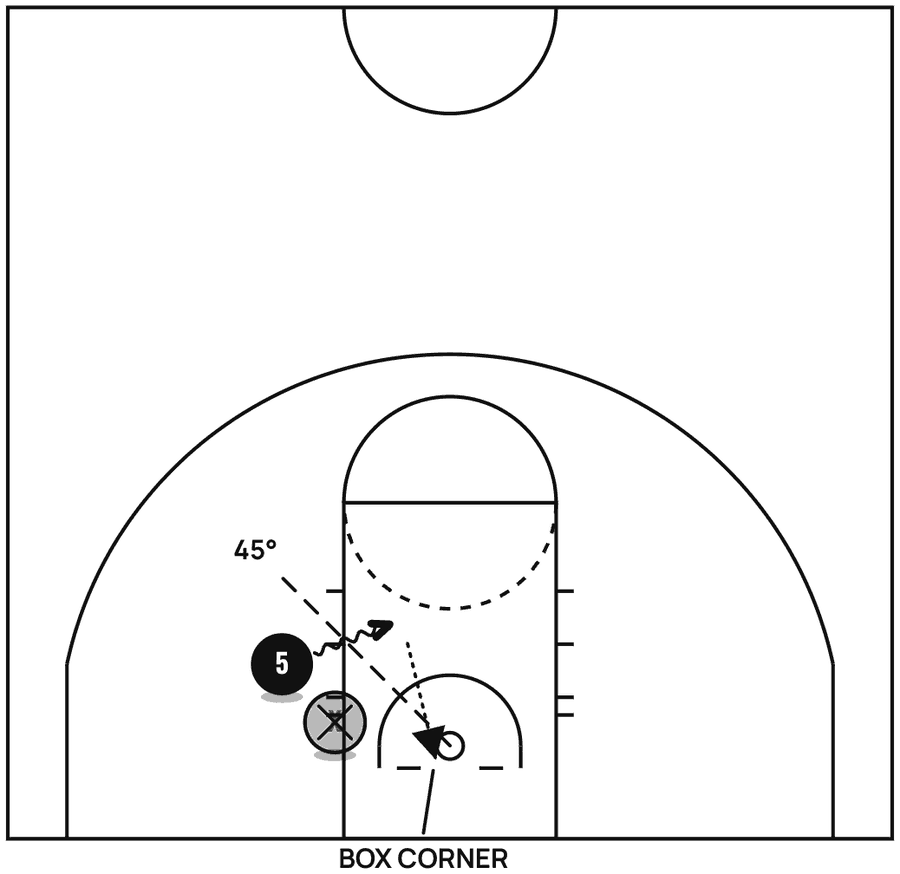 The 5 takes one dribble to the middle, stops on two feet and banks the hook off the top near corner of the box from inside the 45 degree line.
Kevin O’Neill had it in five words. “Shoulder goes to the rim.” Do not open your shoulders. Keep the order ball, body, defender, with the ball on your outside shoulder and your body between the ball and the man guarding you. Know your range, too. The book cites Hal Wissel’s range for the hook at 10 to 12 feet, and has you bank it off the top near corner of the box from inside a 45 degree angle.
He Plays Behind You: Spin Baseline
Pressure straight from behind means he has not picked a side. Spin to the baseline and take one dribble to the power box.
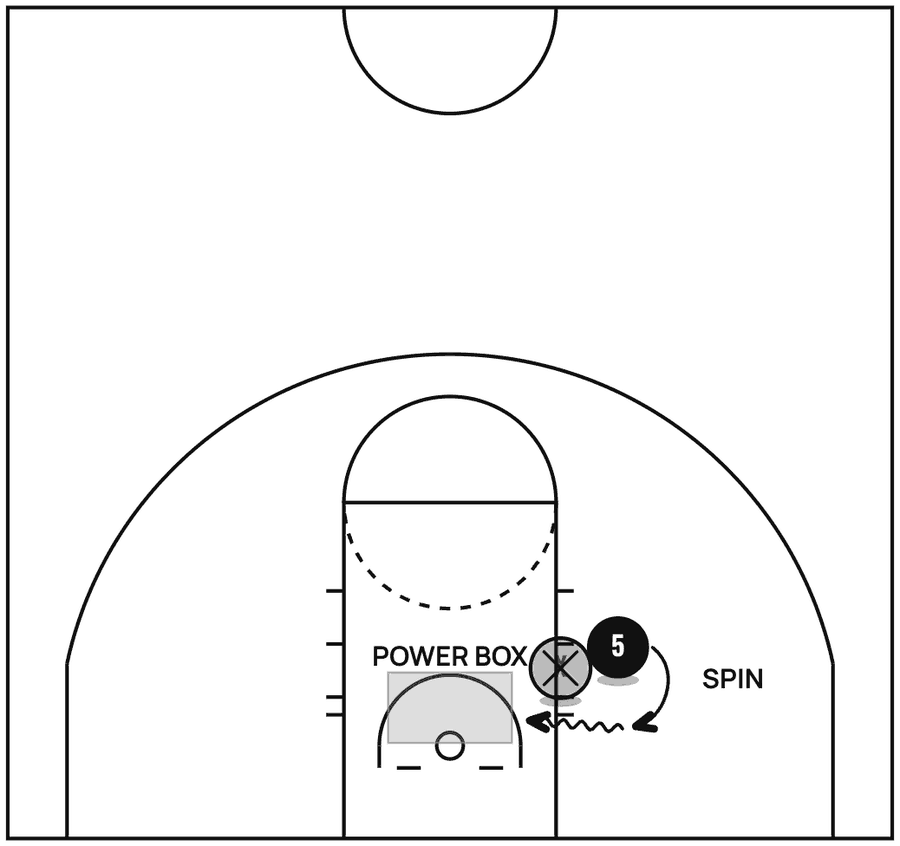 The defender plays straight behind, so the 5 spins to the baseline and takes one dribble into the power box.
When he plays low and wide behind you, use the leg whip. Fake toward the baseline, step your high foot over the top of his high foot, turn around him and shoot a hook off both feet. Do not open your chest to him and do not raise your elbows.
He Plays Off You: Face Up
Some defenders back off on the catch. That space is yours. Reverse pivot to face the basket, keep the ball high, then shoot or drive. That reverse pivot has its own name, the Sikma.
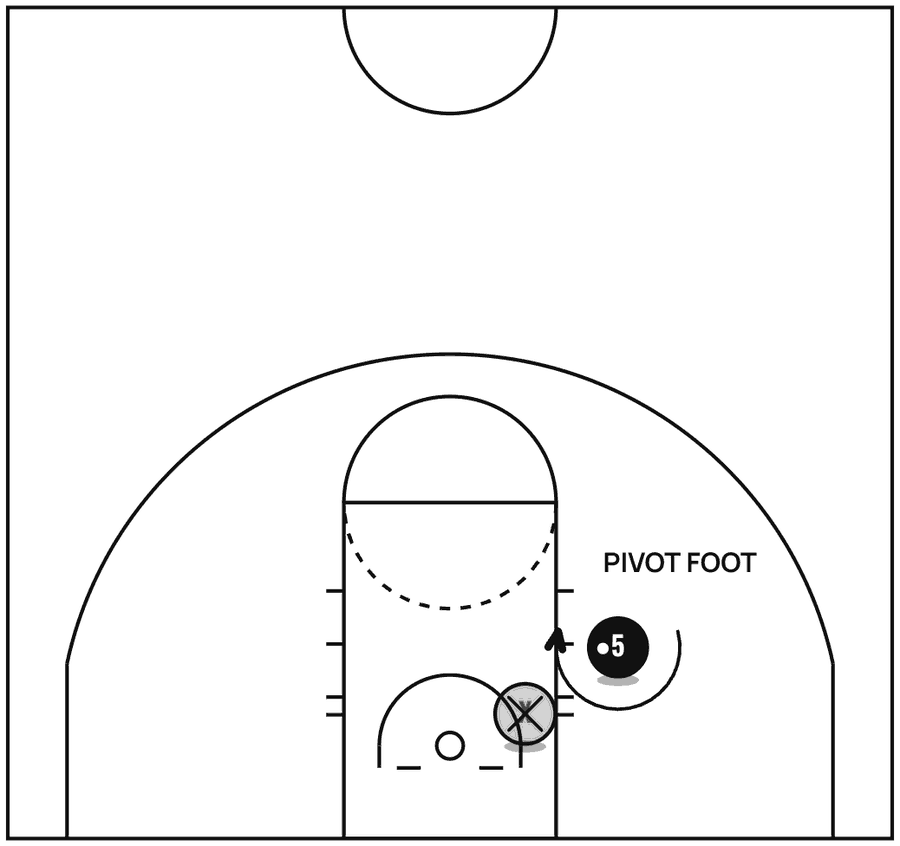 The defender backs off, so the 5 reverse pivots on his inside foot, the dot, to face the rim with the ball high.
If he gives you room and you can make it, shoot. If he closes in, shot fake and drive past him with one dribble. Do not fade away. A fade gives the defender room to block it.
Up and Under
The up and under beats a defender who leaves his feet. Start it like the jump hook. Fake, take one or two dribbles to the middle, stop on two feet with your chest to the sideline, and shot fake to get him in the air. On the left block, your left foot is the pivot. Step through with your right foot and finish with your left hand.
How Many Post Moves Does a Player Need?
Fewer than you think. In our program we teach three: drop step, up and under and face up. The book’s favorite ladder comes from La Salle Academy:
Know four, practice three, use two, master one.
Rick Majerus wanted one go-to move and one counter. David Thorpe set the bar for the go-to move at finishing it 80 percent of the time against a player your size or shorter. And whatever the moves are, slow them down. Majerus had three words for it: low, slow, under control.
Post moves are only half the job. If your post cannot get the ball, start with Chapter 2 of the book, Getting Open and Sealing. To build an offense around your bigs, see the high-low offense guide.
Frequently Asked Questions
What is the first post move to teach? The drop step. It sits in the basic group of moves for a young player, and it is one of the three moves our program teaches, with the up and under and the face up.
How do you know which post move to use? Feel where your defender plays when the ball reaches your chin. High side means drop step baseline, low side means turn to the middle, behind means spin, off you means face up, no pressure means jump hook.
Should a post player dribble? Coaches differ. Don Meyer said less is more and do not dribble with a foot in the lane. Others allow one dribble into the power box. Know your coach’s rule before you catch.
What is the Sikma move? A reverse pivot to face the basket when your defender backs off on the catch, with the ball kept high so you can shoot or drive.
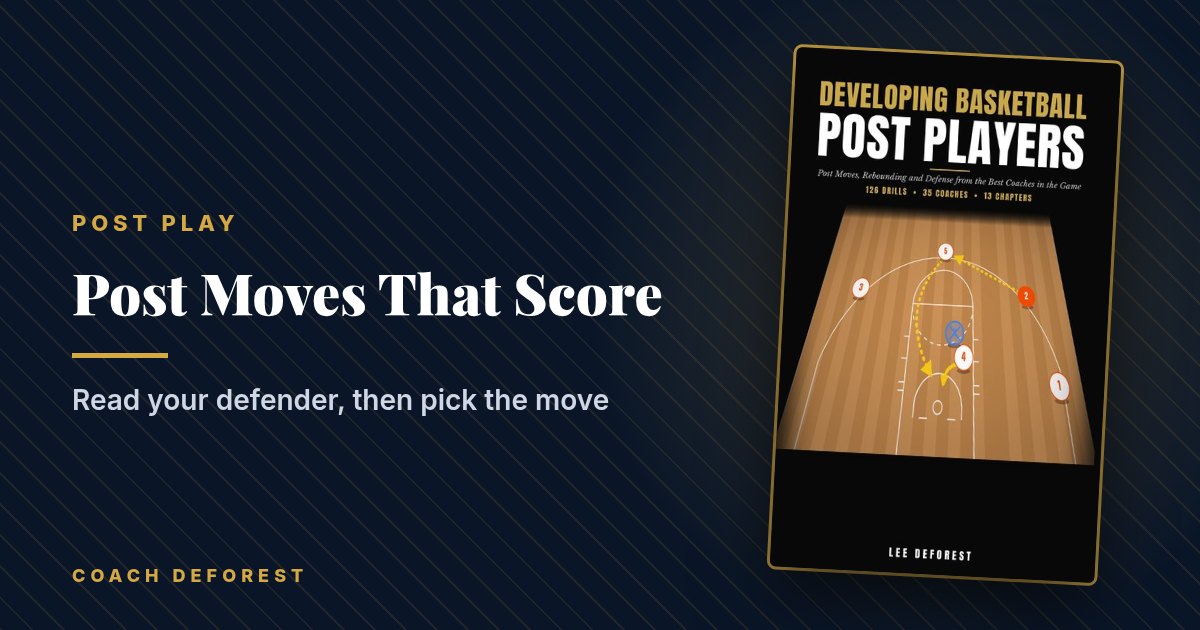
Get every move, drill and practice plan in Developing Basketball Post Players, in paperback and hardcover.