
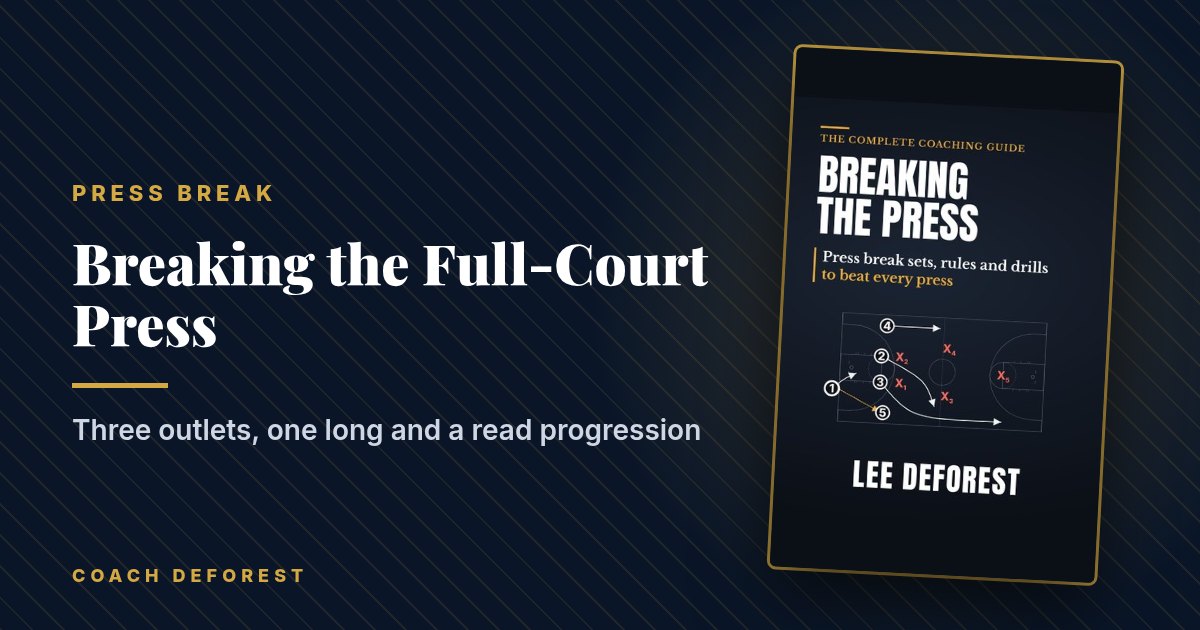
A good press break gives the player with the ball three close passing options and one long one: a sideline outlet, a middle outlet, a reversal back behind the ball, and a fourth player stretching the floor. Pass ahead before the trap closes, get the ball to the middle when the sideline is taken, and refill those jobs every time the ball moves.
That is the base of my book The Complete Guide to Breaking the Press. Here is how it works on the floor, including the man to man press break we use and the drill that makes it automatic.
First, Recognize the Press
You cannot break what you have not named. The book teaches three looks:
- Diamond (1-2-1-1). A defender at the inbounder, two across the first line of receivers, a middle interceptor and a deep safety. The first trap can come on the catch near the corner.
- 2-2-1. Two defenders in the first line, two more waiting behind them, one deep. The catch may look comfortable before the next defender joins the ball near the sideline.
- Man pressure and run-and-jump. Defenders follow receivers. In run-and-jump, another defender leaves his man to challenge the dribbler, and a second defender arriving can mean a switch as well as a trap.
If you are seeing the 2-2-1 most, read How to Break a 2-2-1 Press after this one.
The Base Break: Three Outlets and One Long
Every set in the book sits on one rule. Here is how I put it in the book:
Fill the sideline, the middle and the reversal. Keep one long. When the defense brings two to the ball, give the passer a teammate to find.
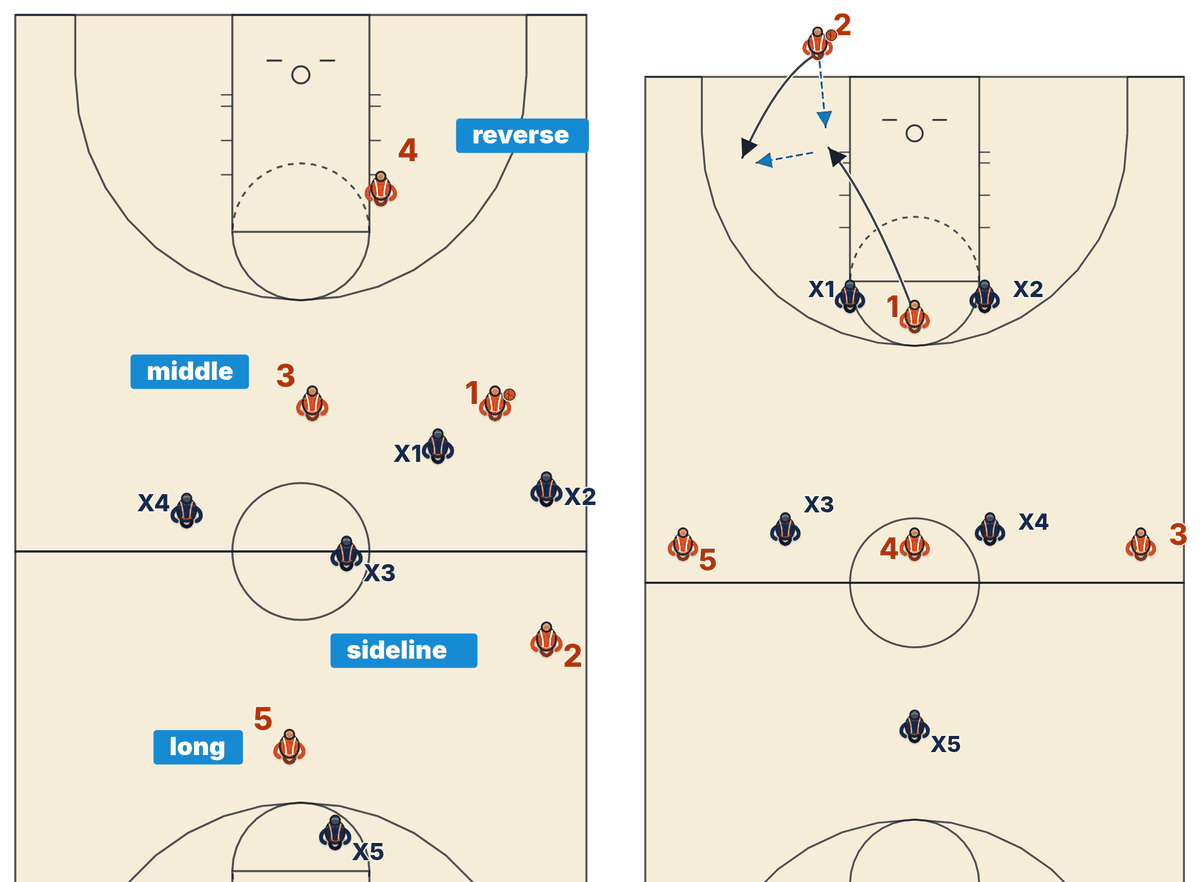 Left: three nearby passing directions with a long receiver beyond the pressure. Right: in Normal the inbounder steps in behind the ball as the return outlet. In 3 Up, 4 runs long instead and becomes the finisher.
The decisions that go with it are short enough to teach on day one:
- Look up the floor on the catch. See the next pass before starting a dribble.
- Pass to advance when the lane is open. A fast pass moves the ball ahead of a recovering defender.
- When a trap closes, receivers move into visible passing lanes. Do not stand directly behind a defender.
- If the forward pass disappears, reverse and refill the sideline and middle on the other side.
- After the first lines are beaten, attack the remaining safety with the numbers you have.
A Man to Man Press Break: Normal and Denied
Against man pressure, the danger is a guard trying to dribble through five defenders by himself. Our set for it is called Normal. The inbounder enters to the first guard, steps into the court and gets it right back.
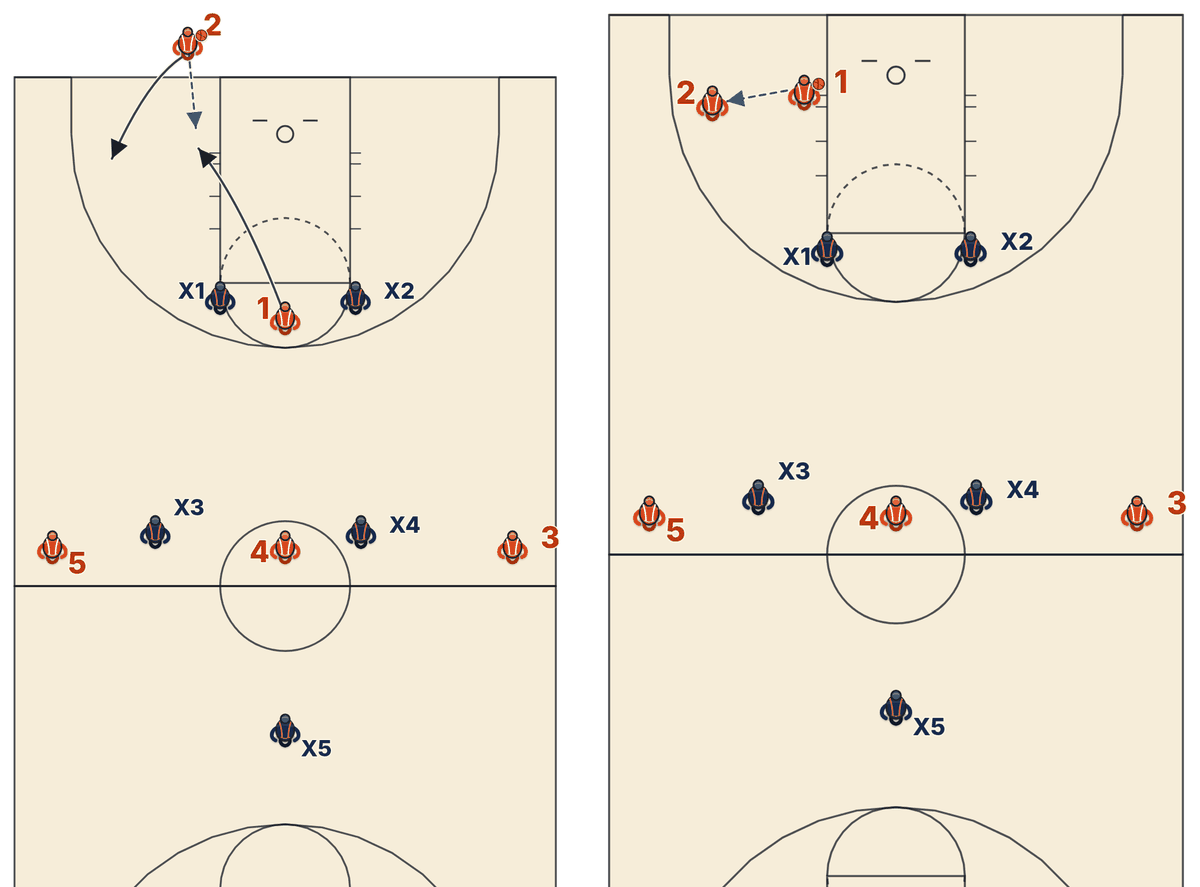 1. 2 enters to 1, then steps into the court. 2. 1 returns the ball to 2.
The book gives the reason in two sentences:
The inbounder becomes a ball handler. The first guard does not have to dribble through the entire press.
After the return, the ball goes to the far side, the next receiver cuts ahead, and the rest fill the lanes. The bench card says it in one line: 2 to 1 to 2, then find the next receiver.
When the first guard is denied, do not force it. In Denied, the post comes back on the side, another receiver moves toward the ball, and the inbounder enters to whoever is open.
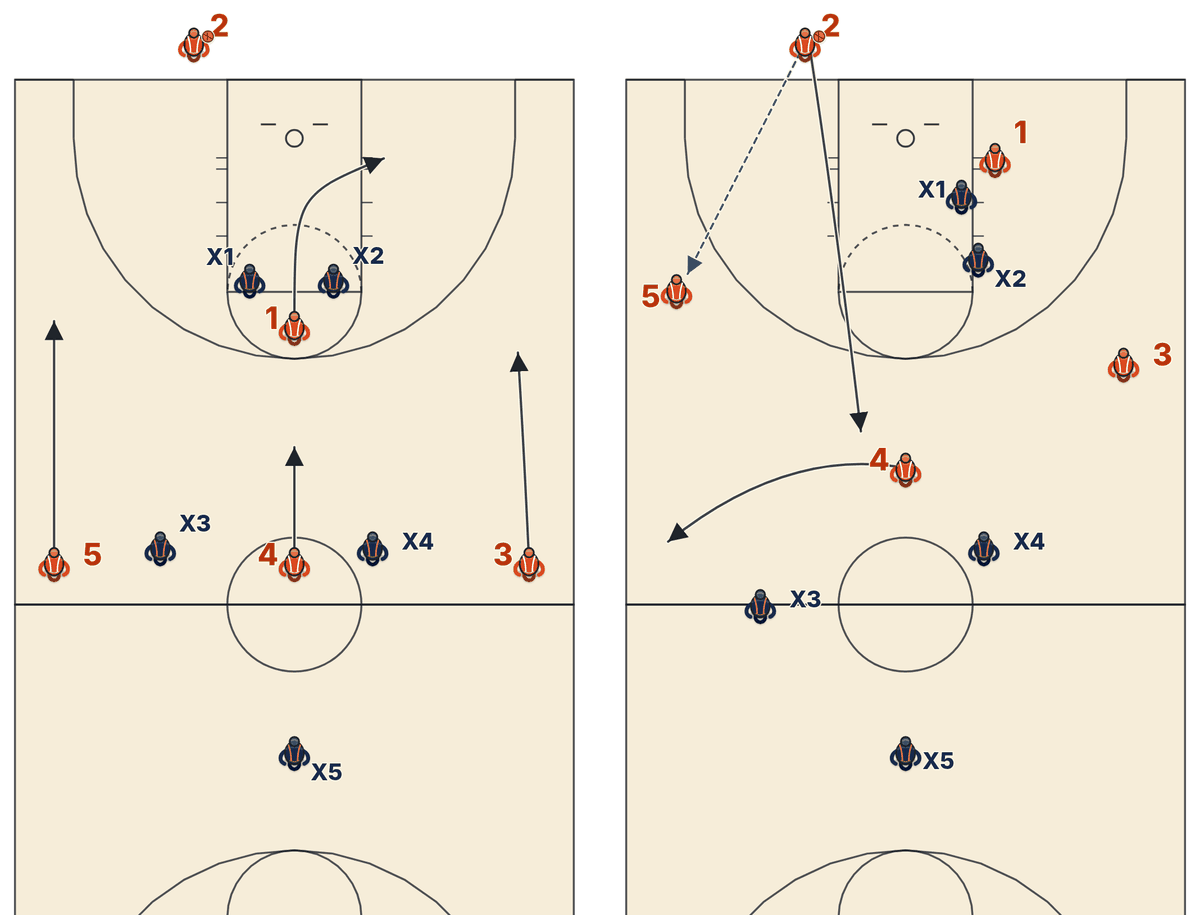 1. The receivers come back as 1 is denied. 2. 2 enters to 5. 2 then moves toward the middle and 4 opens farther up the side.
The card line for it is “Do not force the ball to 1.” A team that knows two entries against man pressure stops panicking on the first deny.
The Read Progression: Sideline, Middle, Long, Back
Once the ball is in, the book teaches the ball handler to read the press like a quarterback reads coverage, in order:
- Sideline. The first look is straight up the sideline.
- Middle. If the sideline is taken, get the ball to the middle. The middle player turns and looks away from where the ball came from, because the far side is where the open runner is.
- Long. If the press has everyone up, throw it over the top. Do not settle for getting across half court. If the runner is open, attack the rim.
- Back. If none of the first three is there, dribble back to the other side and reverse it, with a teammate flashing to the middle.
Then add the Return Break. Your best ball handler inbounds, cuts straight into the middle, and gets it right back. Now the best handler has the ball in the middle of the floor, facing the press.
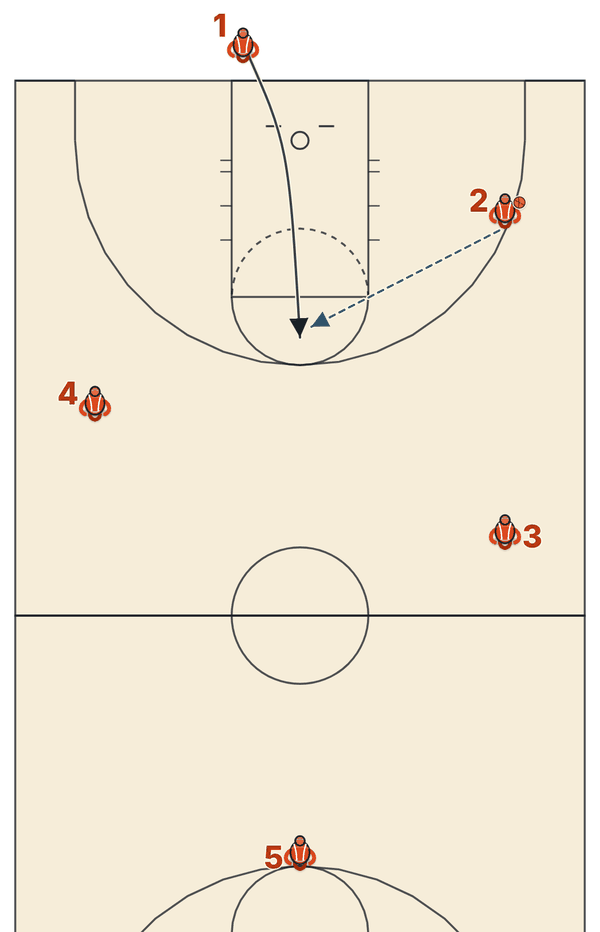 Return Break: 1 inbounds to 2, cuts to the middle and gets it back.
The install order in the book is simple. Day 1: sideline and middle. Day 2: the long pass and the reversal, with the sideline and middle still in. Then the Return Break. Run the whole progression every week.
The Drill That Makes It Automatic
The progression only works in games if it is drilled until it is automatic. The book builds it in four steps over a week, and every rep starts with a made basket by the coach so the inbounder practices on a real cue.
| Step | What runs | Goal |
|---|---|---|
| 5 on 0 | The coach calls a read: sideline, middle, long, back or Return Break. | Every player knows his spot on each read. |
| 5 on 2 | Two defenders trap the first catch. | Pass, don’t dribble, out of the trap. |
| 5 on 4 | Four defenders in the press you will see next. No one deep. | Find the open read. Score if the long pass is there. |
| 5 on 5 | Live to the other end. 1 point for crossing half court with no dribble in the backcourt, 2 for a score. | Beat the press and attack. |
Count turnovers out loud. A rep with a backcourt turnover goes again, and the defense gets the point.
Check Your Rules Before the First Practice
Know your backcourt count. The book lists it as 10 seconds under NFHS (rule 9-8) and NCAA (rule 9-10), and 8 seconds in the NBA and FIBA. Also confirm whether your restart lets the inbounder run the baseline. Use a running-baseline entry only when that restart permits it.
Frequently Asked Questions
What is the best press break for a youth or high school team? One break learned well. The book’s advice is to learn one primary break thoroughly before adding variations. Start with the three outlets and one long, plus Normal against man pressure.
How do you break a man to man press? Make the inbounder a second ball handler. Enter to the first guard, step in for the return, and swing it to the far side. If the first guard is denied, enter to the post coming back instead of forcing it.
Should you dribble against a press? Look to pass first. See the next pass before starting a dribble. Keep the dribble alive before a trap, and pass, don’t dribble, out of the trap once it closes.
How long do you have to get the ball across half court? Ten seconds under NFHS and NCAA rules, eight seconds in the NBA and FIBA.
Every entry, counter and printable bench card is in The Complete Guide to Breaking the Press, on Kindle and in paperback.