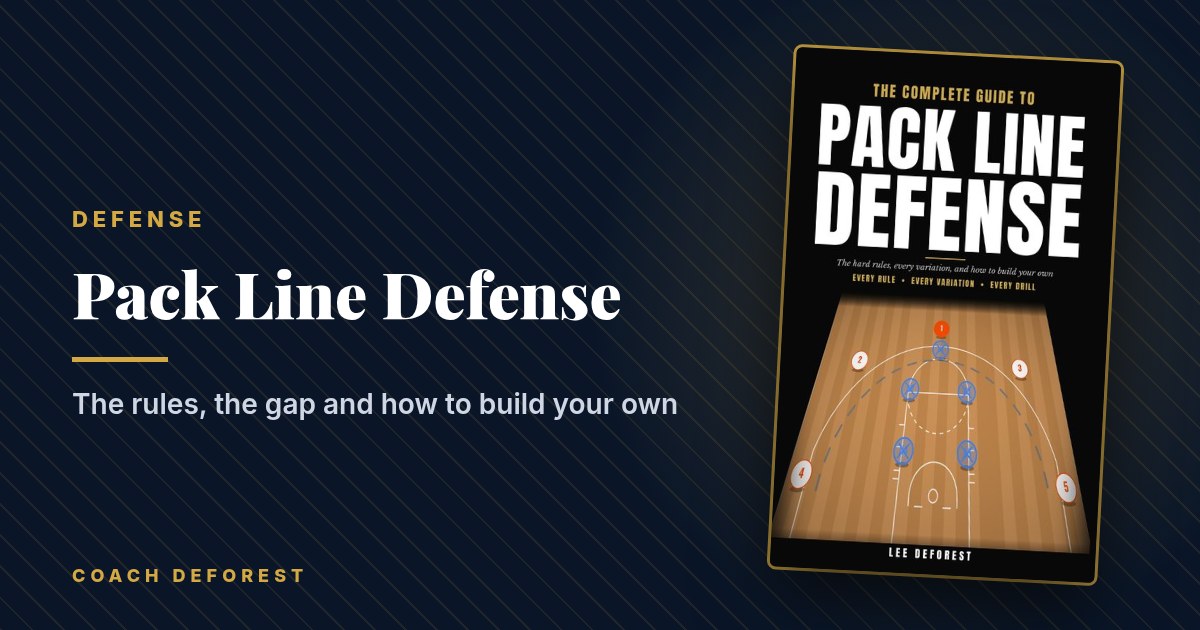


The best Pack Line defense drills are the five you run every day, in the same order: First Step, Protect the Paint, Red/White, the shell package and Post Ambush. Each one gets four to six minutes. Each one attacks one of the four ways Pack Line loses, and each one assumes the drill before it held.
I wrote a whole chapter on this in Pack Line Defense. If you are new to the system, start with Pack Line Defense: The Rules, the Gap and How to Build Your Own. This post is about what you do in the gym.
Why These Drills
The chapter opens with the problem the drills solve:
Pack Line loses in four ways. The help is late. The first step is a lunge. The post catches with two feet in the box. Nobody recovers to the kick-out.
The daily drills force those four problems into the open and put a score on them. The book quotes Larry Brown on the standard:
“The drills we do must be basketball specific and must correlate directly to how we play.”
Why the Order Matters
Each drill assumes the one before it held. If First Step is ugly, Protect the Paint is a two on one every trip. If Protect the Paint is ugly, the shell is for show. If Red/White is ugly, every down screen in the shell finds a defender who is screen bait. If Post Ambush is ugly, the post box rule is only a speech.
Name three mistakes every day, out loud:
- Big triangles. A big triangle gets screened. He sold out, and he is screen bait.
- Over-correcting. The first step was a lunge and he got crossed. That is a layup.
- Defending behind the ball. Help is at the level of the ball, toward the rim.
1. First Step
One on one, two hard dribbles at a 45-degree angle, no help. The job is to teach the first step as a way to contain. Watch for the over-correct. Cue the big step, then cue the square.
Know what it does not teach. There is no recover in it and no contest on a pull-up. A player can win this drill and still give up the corner three later.
2. Protect the Paint
The book calls this the most important drill you run. Its job is to make the paint expensive.
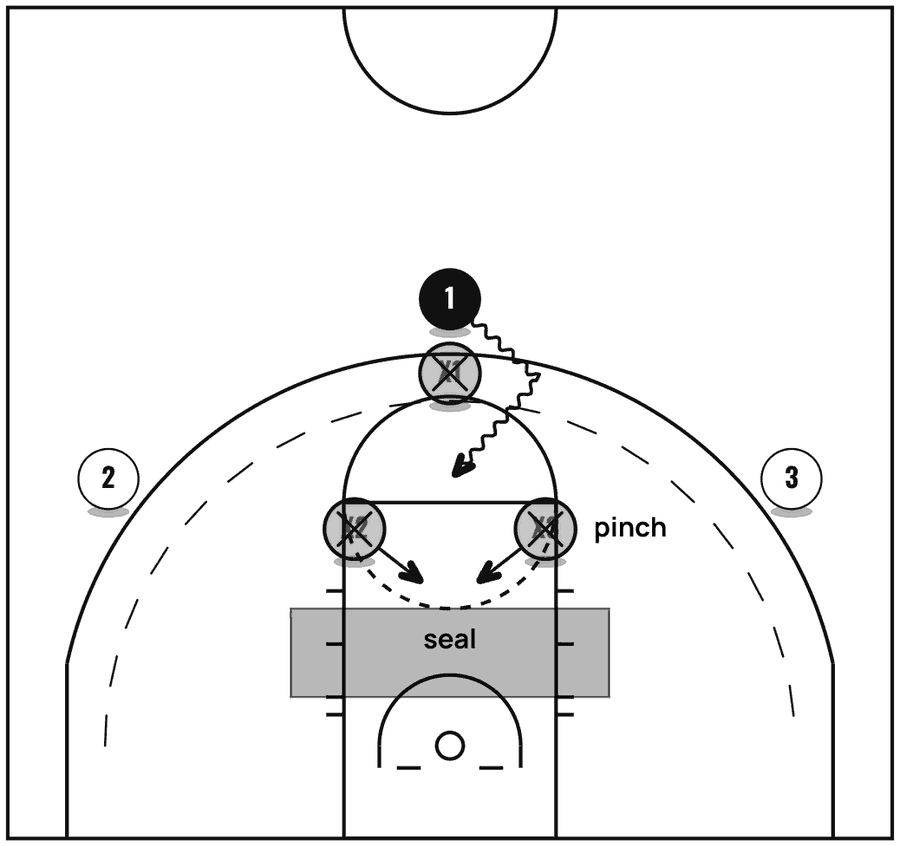 Three on three with the ball at the top: X2 and X3 start pinched with a foot in the paint, and when the ball is driven they seal together at the top of the box.
Three on three. The offense stays in its spots and has five passes to get the ball into the box. The defense goes off after every possession, and the points pay more for keeping the ball out than for a stop after it gets in. Do not celebrate a scramble after the ball is in.
The common miss is help behind the ball. The next miss is over-help that turns into a trap. Then the kick-out is a rhythm three. If the ball keeps getting into the box on day one, stay here.
3. Red/White
Red/White trains your off-ball defenders when the ball cannot bail them out.
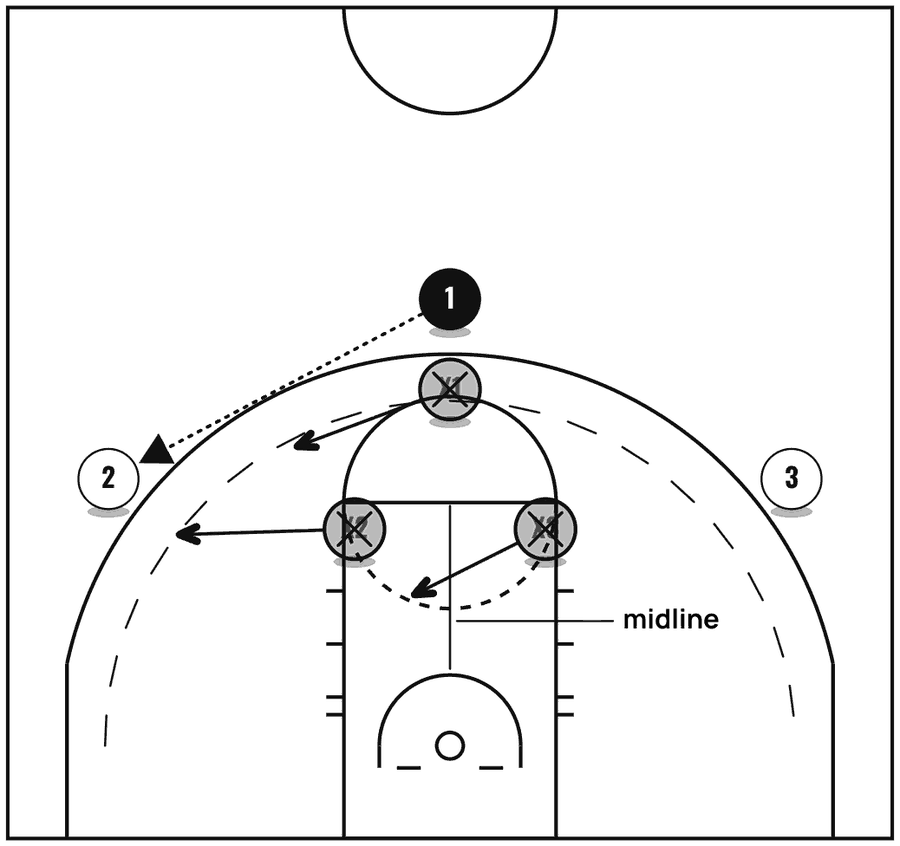 The ball goes to the wing: X2 goes out to the ball without pressuring it, X1 jumps to a small triangle and X3 gets to the midline.
Three on three. The defense starts on the baseline. The offense cannot dribble, and after a pass, the passer screens away. No ball screens, no post-ups, no flares. The defense puts no pressure on the ball.
The constraints are the point. If the offense can dribble, a lazy triangle still looks fine because the on-ball defender can recover. The defense has six musts:
- Call names.
- Do not be screen bait. Move.
- Under the chin on the catch.
- Contest above the eyes.
- No uncontested shots.
- Headhunt.
If the offense scores, or the defense misses a must, the defense goes to the back of the line. A defense that gets the stop becomes the offense. The losing side runs at the end. Do not go live until the no-dribble week looks clean.
4. The Shell Package
Four on four, ten minutes on a clock. Call the name of each piece, then give the cue for that minute. Pick one ball-screen coverage for the day. Hard show is the default.
The danger is walking through it. Give the offense a reason to go hard, or the shell teaches fake triangles.
5. Post Ambush
Five on five. The job is to make the post catch a trap, then make the kick-out a contested shot. You allow the corner pass and the entry from the corner, and the offense gets two passes out of the trap. Keep the entry scripted until the X-out is clean before you add a live post who ducks in or seals the ambusher.
Drills for the Days You Need Them
Circle the Wagons. First-bounce help from a worse start.
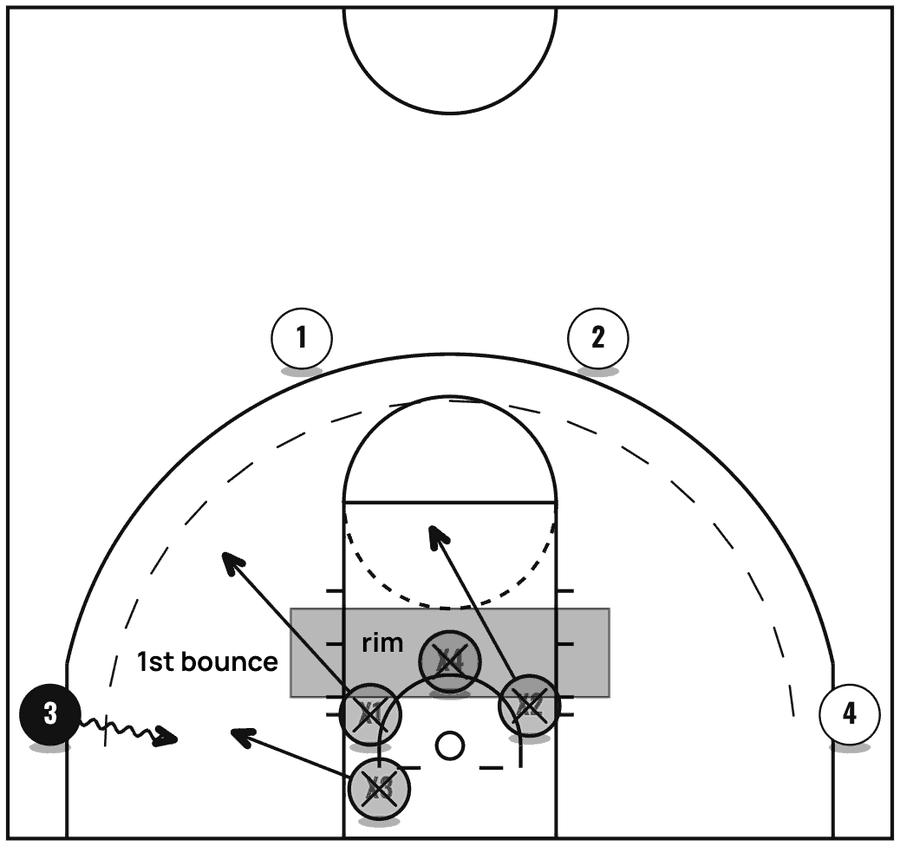 Four defenders start under the net, the corner player drives the baseline, and one defender meets him outside the box on the first bounce while the other three get to the gap and the midline.
The winner stays on defense until it loses. The defense scores one for a stop and four for a charge. Use it when first-bounce help is the week’s leak. Protect the Paint stays in.
The Fundamentals Game. Eight minutes with a 45-second shot clock, and only the defense earns points. One point for a great first step, great first-bounce help, a great contest, a great midline, all five in 911, or ripping through a screen to an under-the-chin catch. Three for a shot-clock violation. Four for a charge. Nothing for a steal. A foul or a missed blockout sets the defense back to zero. Run it when your ledger is full of gambles. As the book says, run this before you lecture.
The Twenty-Minute Individual Plan
If you have extra time, the book has a twenty-minute plan with a cue for every minute. A few of them:
- First step, one minute. “Big first steps.”
- Headhunt, one minute. “Go get his butt.”
- Two-on-two skip-pass contest, two minutes. “Hand above the eyes.” “Sell out.”
- Two-on-two down screens, one minute. “Under his chin on the catch.”
- Three-on-three first-bounce help, two minutes. “Meet him outside the box.”
Managers can be the offense in everything but the one on one.
Build the Week Around One Leak
If you run all five and still give up layups, something is leaking. Find out which hole opened before you add a sixth drill. On film, hunt the leak the week is built for. Do not hunt every row on the ledger.
For a man to man system that pressures instead of packs, see Man to Man Defense Basketball: The Rules on One Page. The Pack Line play page has the half-court picture.
Frequently Asked Questions
What drills should you run for Pack Line defense? Five every day, in order: First Step, Protect the Paint, Red/White, the shell package and Post Ambush, four to six minutes each.
What is the most important Pack Line drill? Protect the Paint. Three on three, the offense has five passes to get the ball into the box, and the scoring pays more for keeping it out than for a stop after it gets in.
How long should Pack Line drills take? About four to six minutes each, so the daily five fit in roughly half an hour. End a drill while the constraint still bites.
Why can’t the offense dribble in Red/White? If the offense can dribble, a lazy help triangle still looks fine because the on-ball defender can recover. No dribble makes the off-ball defenders earn it.
The full install, scoring and practice plans are in Pack Line Defense, on Kindle, in paperback and in hardcover.