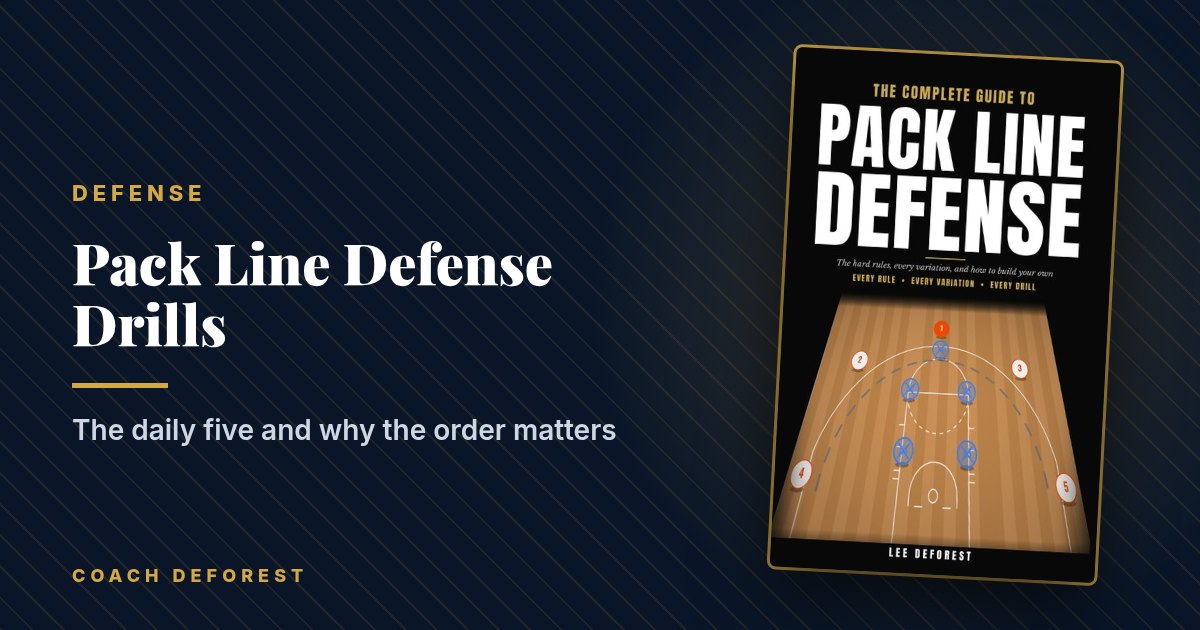


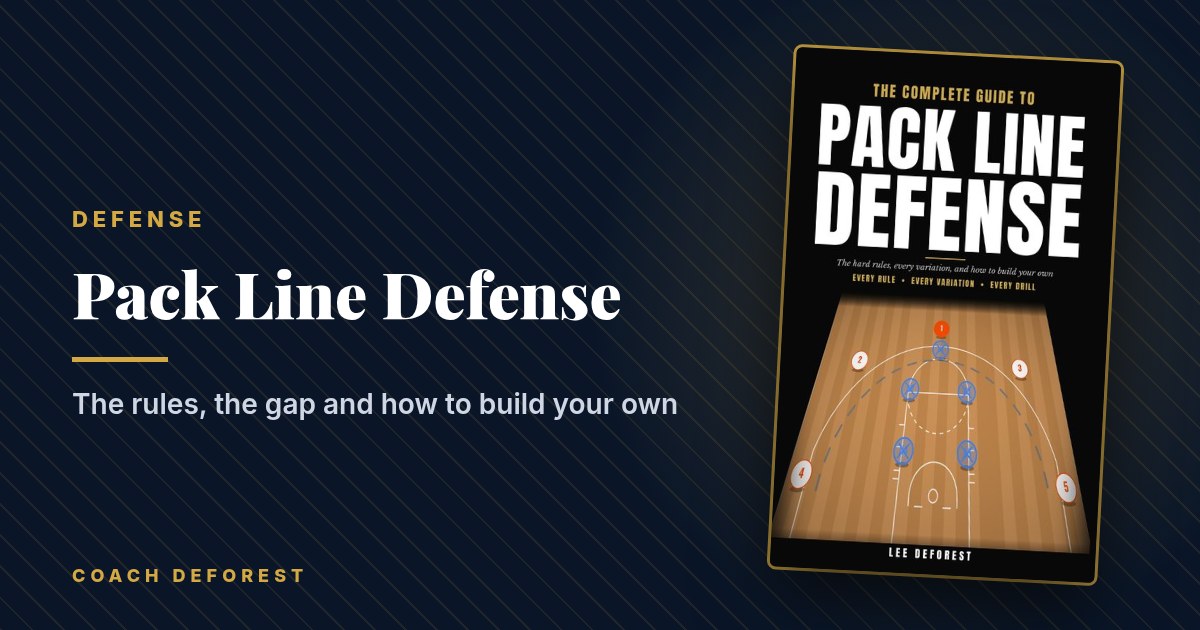
Most coaches have heard of Pack Line. Fewer have a clear picture of what makes it work, or which parts of it they can change without breaking it. That is the reason I wrote a whole book on it. This post covers the core of the system and where you get to make your own choices.
What Pack Line Is
Here is how the book opens:
Pack Line is a half-court man-to-man defense. One defender pressures the ball. The other four stand inside an imaginary line, one step inside the three-point arc, and keep the ball out of the paint.
It is man to man, and nobody plays it alone.
Five players work together to get one stop. The player on the ball can pressure because four teammates are already behind him in help. Those four can sit in help because he is making the ball handler uncomfortable. Take away either half and the other half stops working.
Pack Line became known through Dick Bennett’s teams at Wisconsin, and coaches at every level have copied it and changed it ever since. That is why you will find so many versions.
What It Takes Away, and What It Costs
A defense is a trade. Here is what Pack Line takes from the offense:
- Layups.
- Straight-line drives.
- Baseline drives.
- Post catches with two feet in the post box.
- Rhythm threes off a broken closeout.
- Easy baskets in transition.
And here is the price, stated plainly:
You will give up some catch-and-shoot threes. If your defender is late on the closeout, the shooter gets a clean look. That is the bet. You would rather live with a contested jump shot than a layup.
Offenses know this, so they attack with skip passes, flare screens and the kick-out after your help comes. The recovery has to be taught as hard as the gap.
Two Rules the On-Ball Defender Never Breaks
Pack Line makes the on-ball job smaller. The defender is only asked to be good in a small space, about three feet either way. That is his yard. Inside it, two things are never allowed.
No baseline. Your help-side defenders stand where they do because nobody gives up the baseline. A drive to the outside goes where your help is not.
No straight line. In the book’s words:
A straight-line drive goes from the spot of the catch directly to the rim. No help position can stop it. It often starts with a poor closeout.
Then comes the part that makes it real:
Make it non-negotiable. It is all about what you emphasize. Tell your team that a player who gets beat baseline comes out of the game, and then do it.
The Gap: Position Is Help
When your man does not have the ball, you check three things. You are about halfway between the ball and your man. You are a step off the line that would connect the ball to your man. You can see both of them. The ball, your man and you make a flat triangle.
Keep the triangle flat. Play too tight to your man and the drive opens up beside you. Sag too far off and you have a big triangle.
An off-ball defender can be asked to deny, to help and to recover. Nobody can do all three, so Pack Line drops the denial and keeps the other two. Your players do not go to help. They line up in it. That also changes what you coach:
The help rarely gets you beat. The recovery does, or the lack of one.
So drill the recovery over and over. The same goes for closeouts. A pack defense does not deny, so your players close out all night.
Build Your Own: The House Rules
Pack Line is one idea with a lot of house rules. The idea is simple: pressure the ball, pack the other four inside the line, keep the ball out of the paint. The rules around it change from coach to coach. Take the line itself. The default in the book is one step inside the arc. Some coaches set it two or three feet inside. Others measure from the rim, 16 feet for some and 17 for others. The book gives you a way to pick:
Quicker feet, closer to the arc. Slower feet, closer to the rim. Whatever you pick, tape it on the floor for the first two weeks. Players follow a line they can see.
Every one of the 13 house rules works the same way: a default, the other ways coaches run it, and how to pick. The advice on changing them is just as direct:
Start with the default. Change one thing at a time. If you change three, you will not know which one helped.
Count Your Stops
Defense is judged by its result, so the book has you count stops. A stop is about ten seconds of defense, no layup, no uncontested shot, and the first rebound is ours. A few weeks in, you should see the transition layups stop, your fouls drop and the offense get fewer clean looks. You will also see one more thing:
Your offense cannot score on your defense, and that is the sign the pack is working.
The book also includes a ledger, a player scorecard for games, scrimmages and film. Players earn points for plays like a charge and lose points for things like a costly gamble, where a player leaves the gap for a steal that does not come. The totals show you what to fix in practice and who starts the next game.
Where to Go From Here
Pack Line Defense: The Hard Rules, Every Variation, and How to Build Your Own has 21 chapters and 127 court diagrams. It covers the hard rules, closeouts by shooter type, the post, ball screens, off-ball screens and cutters, transition, rebounding, out-of-bounds defense, a change-up press and trap, the daily drills, a two-week install, scouting and the ledger.
- Read more about the book on the Pack Line Defense book page.
- Get it on Amazon: Kindle, paperback or hardcover.
- See the short version on the Pack Line Defense play page, or compare it with the denial approach in The Switching Pressure Denial Defense.
Dick Bennett does not sponsor or endorse this book.