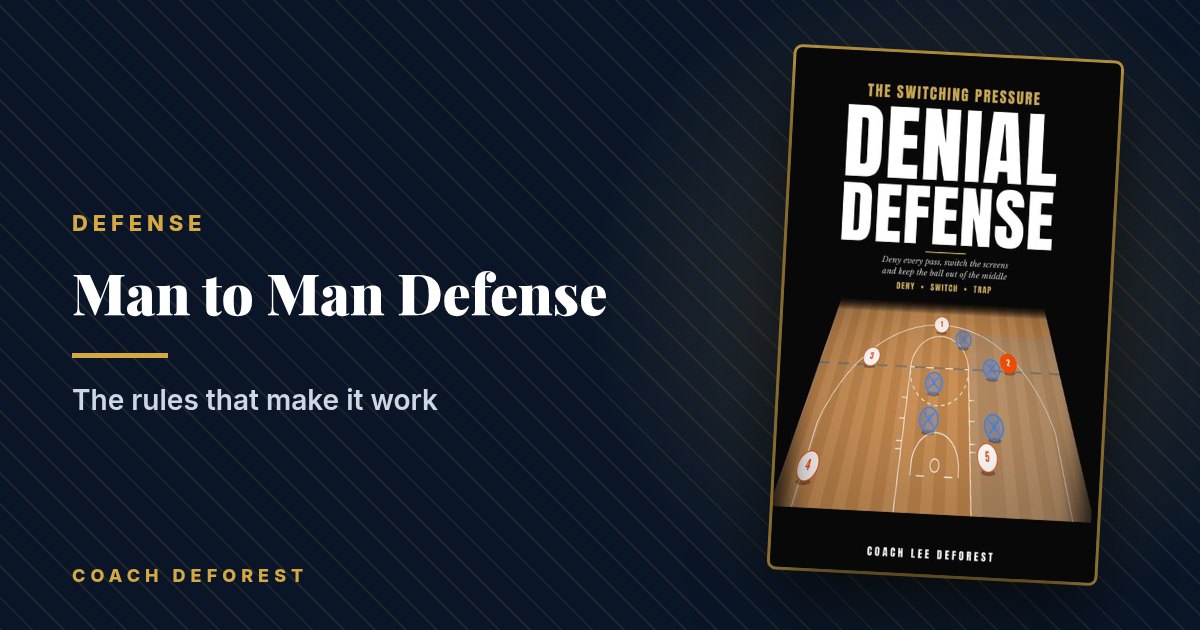


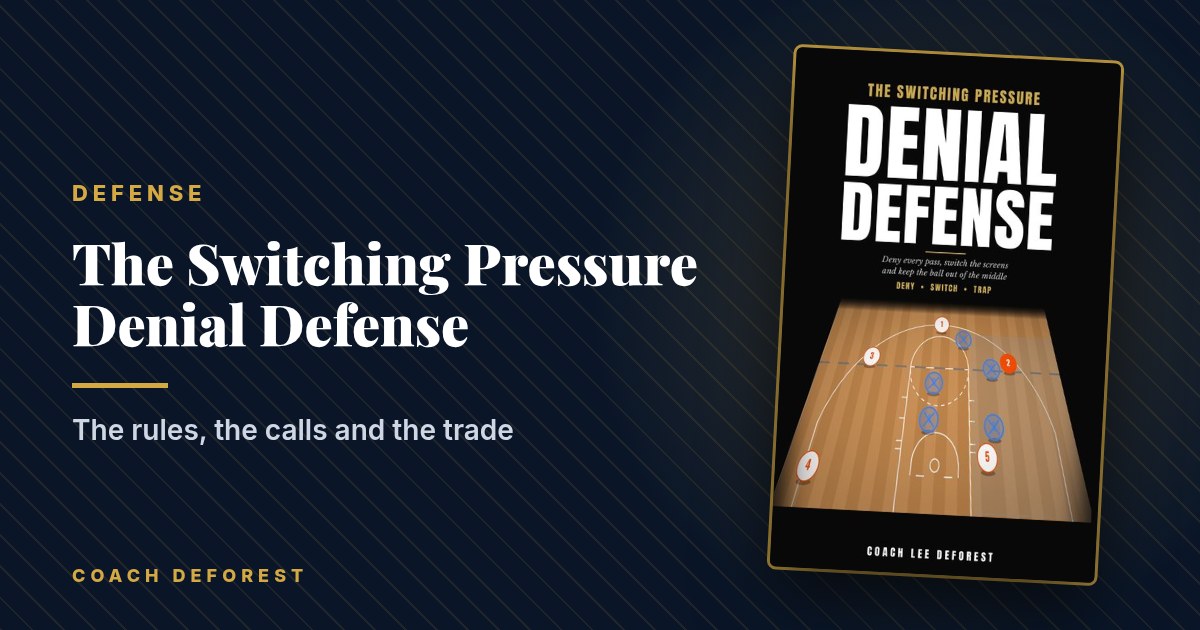
Every defense makes a trade. That is the first idea in my new book, The Switching Pressure Denial Defense, and it is the best place to start if you are deciding whether this system fits your team.
Every defense makes a trade. You take some things from the offense and you leave others open. Know both halves and you can teach it straight and fix it when it breaks.
The Whole Defense in One Sentence
Pressure the ball, deny every pass one pass away, keep the ball out of the middle, switch screens between players who can guard each other, and trap in two spots only.
The book boils that down to a one-page rule list: pressure the ball, deny one pass away, no middle, switch like for like, trap in two spots, one shot. Every situation in the defense gets one base rule first, with the words your players say, the spots they take and the drills that build it.
What It Takes Away
A comfortable ball handler. Everything starts with pressure on the ball. Denial and ball pressure work as a pair, and your denial will only ever be as good as the pressure in front of it.
The middle of the floor. The book uses a picture to explain why you send the ball to a sideline:
Think about catching a loose animal. Chasing it, or trying to cut it off, gets you nowhere. You herd it into a corner.
The pass back to the top. With the ball on one side, the pass that would swing it back is denied. The handler has two choices, a dribble or a hard pass. That matters because a reversal is the moment a defense is easiest to hurt, when every defender changes jobs at once.
Free cutters off screens. Players today are too big and too skilled for a defender to fight through every screen, so screens between like players are switched. The book lists the reasons coaches give, including that the passing lane to the cutter stays covered and that a set switch takes away the gray areas that get a defender beaten.
The second shot. The goal is one shot for the other team on each trip, and all five players block out.
What It Gives Up
I think this is the section that makes the book useful, because it tells you what you are signing up for.
The back cut. Hard denial leaves one route, and the book says so directly: “Hard denial leaves one cut, the back door. That is on purpose.” The answers are pressure on the passer, weight on the back leg and opening to the ball with a reverse pivot when a defender is beaten.
The mismatch. Any team that switches will sometimes put a small defender on a big player. The first answer is to switch only players who can guard each other:
Switch like for like. Off the ball, the switch is for players who can guard each other: guard for guard and big for big. A screen with a guard and a big in it is not switched.
More help on the drive. A team that gets up into the ball needs more help when the dribble gets through. The answer is the help side, which the book teaches as “help” from the beaten defender and “fill” from the helper.
Rest. There is no resting in this system:
There is no stance and no spot on the floor where a defender in this system gets to rest. The pressure never lets up, and it stays under control.
It also takes all five. Three or four players working at it will not be enough.
Ten Calls, One Language
A pressure team cannot play quiet, so the book gives your team one short list of words, each with one meaning tied to one situation. The ten calls are ready, point, stick, ball, help, fill, shot, screen left, screen right and switch. Three of them name the stances on the ball. “Stick” is the one that has to be heard in a game:
The ball defender says it the instant the dribble ends. His teammates cannot always see the ball, so the word is their warning.
Once the defenders hear it, they know the drive is gone and can deny their men all out.
Who It Fits
The book names the kinds of teams that tend to choose this defense: teams that are giving up talent, and teams with alert guards. It also shares an image I like for teaching it:
Teach your players to see themselves as tied together by one cord, with the ball tied in too.
When the ball moves, or a man moves, the cord pulls on everybody and every defender adjusts.
What Is in the Book
The Switching Pressure Denial Defense: Deny Every Pass, Switch the Screens and Keep the Ball Out of the Middle has 37 chapters and 411 court diagrams. After the base rules, it shows the other ways coaches run each situation so you can weigh every option, then the install order, practice plans, defensive games, a four-chapter drill book, stats, bench and scouting plans, and three bench cards.
- See the full contents on the Switching Pressure Denial Defense book page.
- Get it on Amazon: paperback or hardcover.
- If you would rather sit in the gap than deny, read about Pack Line Defense.
No coach named in this book sponsors or endorses it.