

Man to man defense means each defender is responsible for one player, but all five guard the ball. Where you stand depends on where your man is. On the ball, you pressure it. One pass away, you deny. Two or more passes away, you help. Add four habits (keep the ball out of the middle, close out on the catch, help and fill on drives, and finish with a block out) and you have a man to man defense.
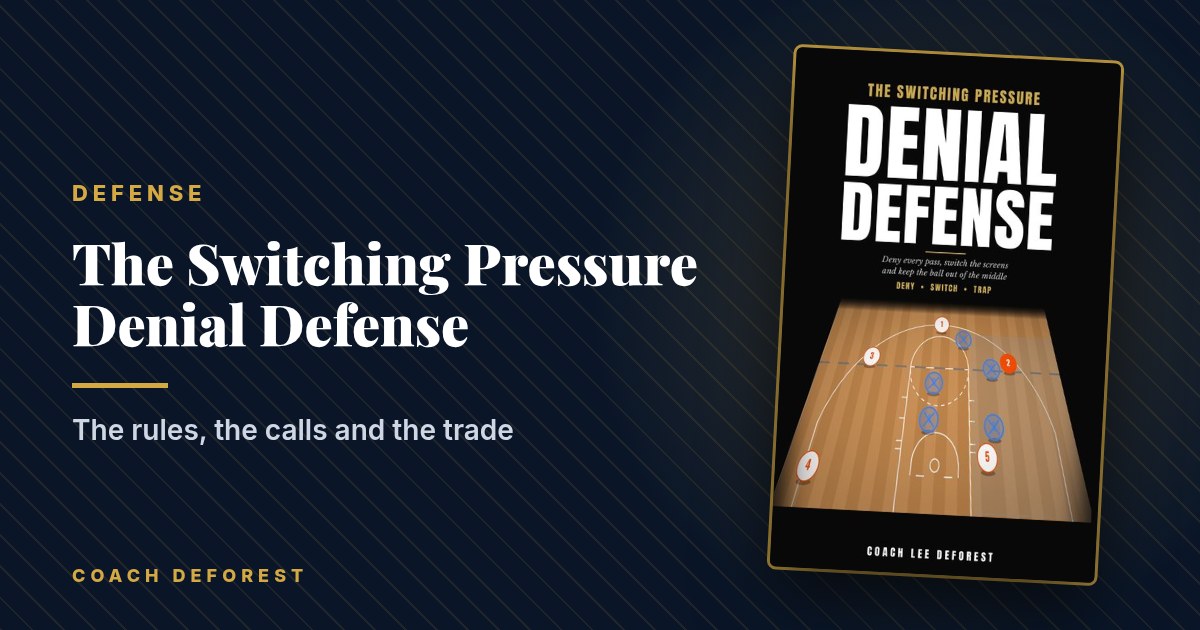
These rules come from my book Switching Pressure Denial Defense. The book’s version switches screens and denies hard, but the principles in this post hold for almost any man to man you run.
The Picture: Everyone Has a Job
The book puts the whole defense on one diagram before it teaches a single drill:
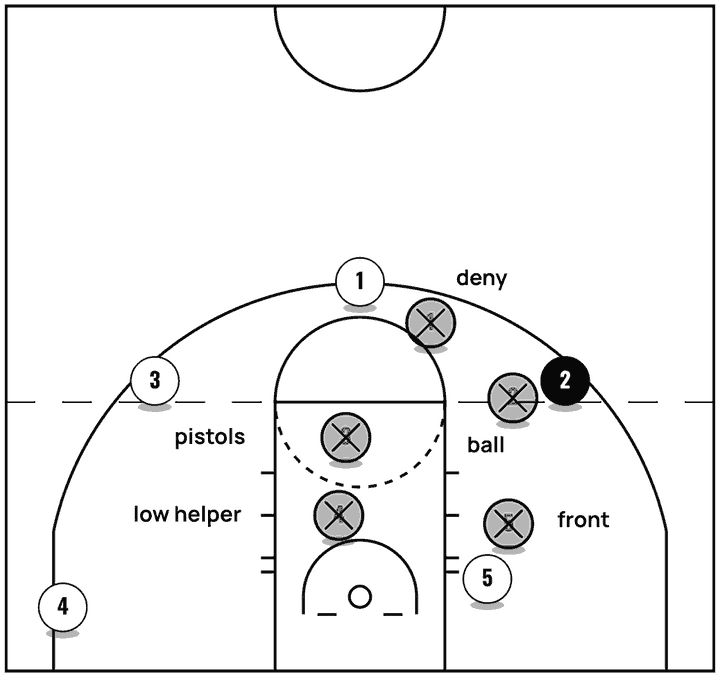 With the ball on the wing, X2 is on the ball, X1 denies, X5 fronts the post, and X3 and X4 are in pistols with X4 the low helper.
Three jobs show up in that picture. The on-ball defender, the deniers one pass away, and the helpers in pistols. Every rule below belongs to one of them.
On the Ball: Ready, Point, Stick
The on-ball defender changes his stance with the ball:
- Ball held, dribble not used. Ready stance. Both hands up, nose in chest, half a man over.
- Ball below the waist or on the floor. Point stance. Inside hand points the ball, heel-toe, short slides.
- Dribble ended. Call “stick.” Close to two or three inches and trace the ball with both hands.
Stay one arm’s length off the ball, except in stick. When a driver keeps coming, wall up: chest in front, both arms straight up.
No Middle
Direction matters as much as stance. With the ball at the top of the key, push it to the sideline at the free-throw line extended. With the ball on the wing, take away the middle and push it toward the baseline. If he turns to the middle, turn him back or push him out above the elbow.
The middle is where a driver has the most passing angles and the help has the farthest to go. Keep him out of it and your helpers know where the ball is going.
One Pass Away: Deny
The defender one pass away denies on the line and up the line. The book’s cues:
Ear in chest, lead arm straight with the palm to the ball, brush hand, weight on the back leg.
When the ball moves, everyone moves while the ball is in the air. On a back cut, open to the ball, reverse pivot and sprint to the basket facing the ball.
How hard you deny is a choice. A pack defense sags off one pass away. A pressure defense takes the pass away. Either way, the defender one pass away is the first line of help on a drive.
Two or More Passes Away: Pistols
The help-side stance in the book is called pistols:
Point both ways. One index finger points at the ball. The other points at your man.
Play off the straight line between the ball and your man by a step and a half up to three steps. Your quickness and the quality of your man decide the distance.
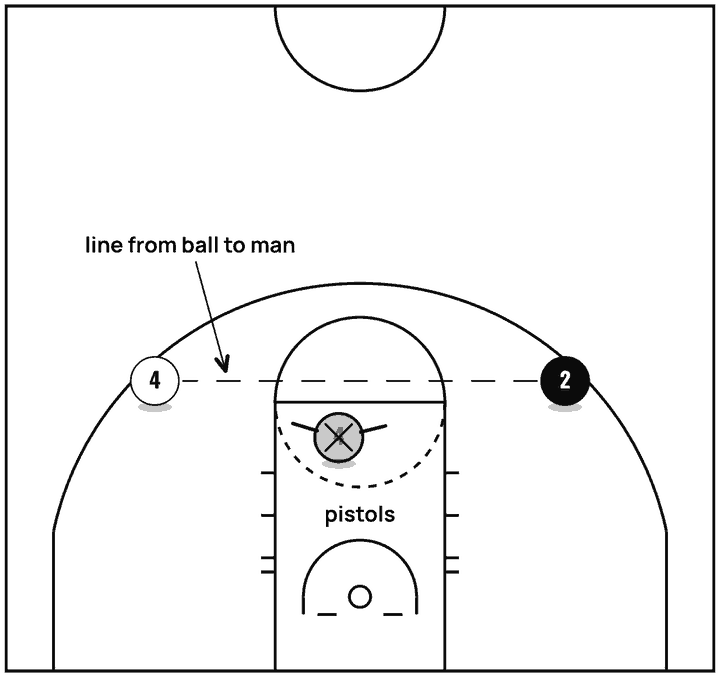 X4 stands in the lane below the line from the ball to his man, with one finger pointed at the ball and one at 4.
The book is honest about why this spot is hard. Most players think it is the place to rest. It is close to the hardest spot on the floor to play, because the helper has to be there when the defender on the ball breaks down.
The line of the ball. Draw a line from the ball straight across to the far sideline. Every defender off the ball plays between that line and the baseline. When a wing dribbles toward the baseline, every defender off the ball drops to the new line.
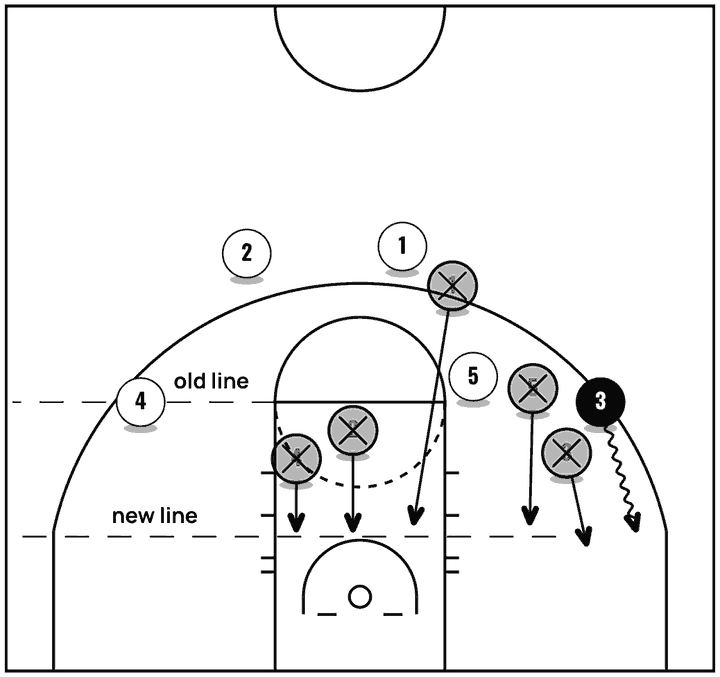 As 3 dribbles toward the baseline, all four defenders off the ball drop to the new line of the ball, and X5 fills down toward the dribbler.
Closeouts: Get There on the Catch
A closeout is any time a defender runs at a free man who has the ball. The book’s rule is to get there on the catch and land on the high shoulder, the one nearer the middle of the floor. That keeps the ball out of the middle.
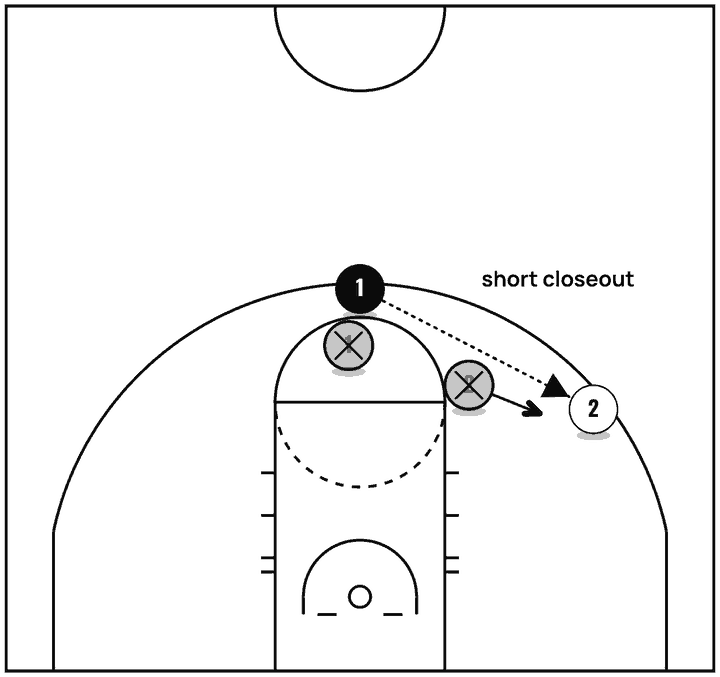 Short closeout: on the pass to the wing, X2 takes one step out of denial and lands on the high shoulder of 2.
Leave early, as the ball leaves the passer’s hand. Get the hands up early. Most players throw their hands up at the very end of the closeout, and by then they are bringing them up underneath the shot. Keep your weight back on the trail leg so you can turn a drive into a point stance.
Help and Fill
When a drive beats the ball defender, the book’s rule is help and fill. He calls “help,” runs back into the key and looks for the open man. The pistols defender meets the driver and says “fill.” A helper who meets the driver gets there and stops, arms straight up, and jumps second.
If you are the beaten defender and the helper has called fill, stop chasing and fill. Chase only when nobody is between the driver and the rim.
Finish the Stop
A shot goes up. The defender on the shooter calls “shot,” and all five block out. The book’s one-page summary ends with the same two words: one shot.
Talk Ties It Together
The book uses ten calls: ready, point, stick, ball, help, fill, shot, screen left, screen right, switch. Each one tells a teammate something he cannot see. A quiet man to man defense is a late one.
If you want the full switching and denial system built on these rules, read Switching Pressure Denial Defense: The Rules, the Calls and the Trade. If you would rather sag and protect the paint, read Pack Line Defense Drills.
Frequently Asked Questions
What are the basic principles of man to man defense? Pressure the ball, deny one pass away, help two or more passes away, keep the ball out of the middle, close out on the catch, help and fill on drives, and block out on every shot.
Where should help side defenders stand? In pistols, off the line between the ball and their man by a step and a half up to three steps, and between the line of the ball and the baseline.
How do you close out in man to man defense? Leave as the ball leaves the passer’s hand, get your hands up early, keep your weight back, and land on the high shoulder one arm’s length away.
Should you force the ball to the baseline or the middle? The book’s rule is no middle. From the top, push it to the sideline at the free-throw line extended. From the wing, push it toward the baseline.
Get every rule, drill and diagram in Switching Pressure Denial Defense, in paperback and hardcover.