

To break a 2-2-1 press, line up four across at the free-throw line extended, throw the first pass to the side, and get the next pass to a receiver in the middle before the sideline trap closes. The 2-2-1 is built to let you catch on the sideline and then trap you there. The middle is where it breaks, and the deep safety cannot cover two runners.
Here is how I teach it in The Complete Guide to Breaking the Press.
How the 2-2-1 Tries to Beat You
The book describes the look this way:
Two defenders show in the first line, two more wait behind them, and one stays deep. A catch may look comfortable before the next defender joins the ball near the sideline.
That is the trick of the 2-2-1. The first catch is easy on purpose. The trap comes from the second line once the ball handler turns and dribbles toward the sideline.
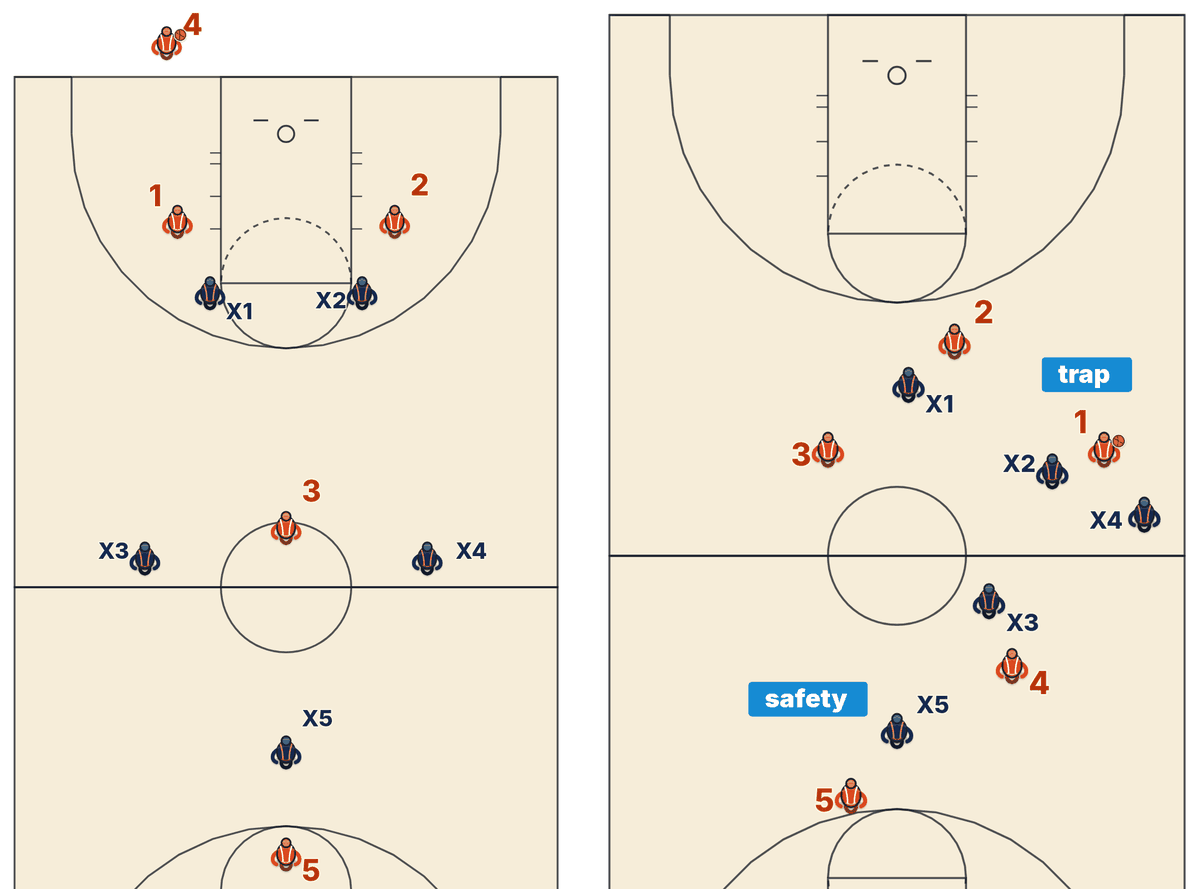 Left: the 2-2-1 shape. The middle space and the second line matter as much as the nearest defender. Right: the sideline trap. Look for a receiver inside the pressure and an outlet behind the ball.
So the first teaching point is a habit, not a play:
Read the second line before putting the ball on the floor.
When the sideline is denied, work through the middle. Refill the outlets when the ball changes sides.
The 1-4 Break Against a 2-2-1
This is the cleanest answer in the book for a team seeing the 2-2-1 for the first time. Start four across at free-throw line extended. The first pass goes to the corner side, and the middle is where the press breaks.
The inbounder takes it out under the basket and enters to the ball-side wing, then cuts in as the outlet. As the ball is thrown in, the ball-side elbow player runs long up the ball-side sideline. The far elbow player cuts diagonally across the floor and stops just short of half court near the ball-side sideline. The last player runs straight up the opposite sideline to half court.
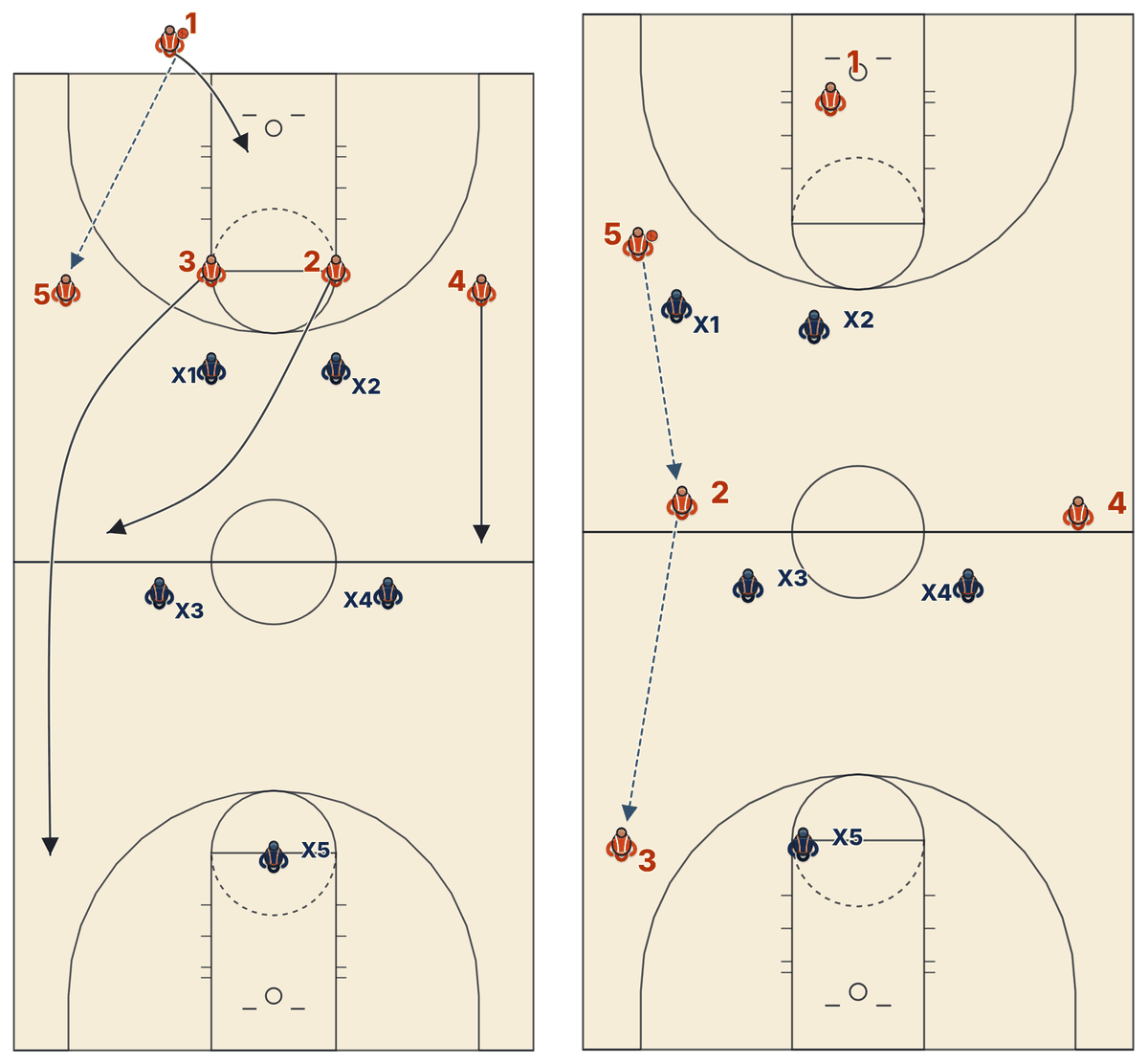 Left: 1 inbounds to 5 and cuts to the basket. 3 runs long up the ballside sideline, 2 cuts across to the ballside short of half court and 4 runs the far sideline. Right: 5 passes ahead to 2 before the trap closes. 2 turns and hits 3 long up the sideline.
The key is the timing of the second pass. The wing passes ahead to the cutter before the trap closes. If he waits, the second line arrives and you are playing the press’s game. The book’s line under the diagrams sums up every press break:
Sideline, middle and reversal passes against any pressure. The middle catch beats the trap.
Four Across: Screen, Come Back, Read the Middle
The book’s other 2-2-1 version also starts four across, with a screen. The post takes it out. One guard screens for the other, and the inbounder can fake toward that action and hit the wing coming back along the sideline. When the defense traps the wing, the middle is the next read.
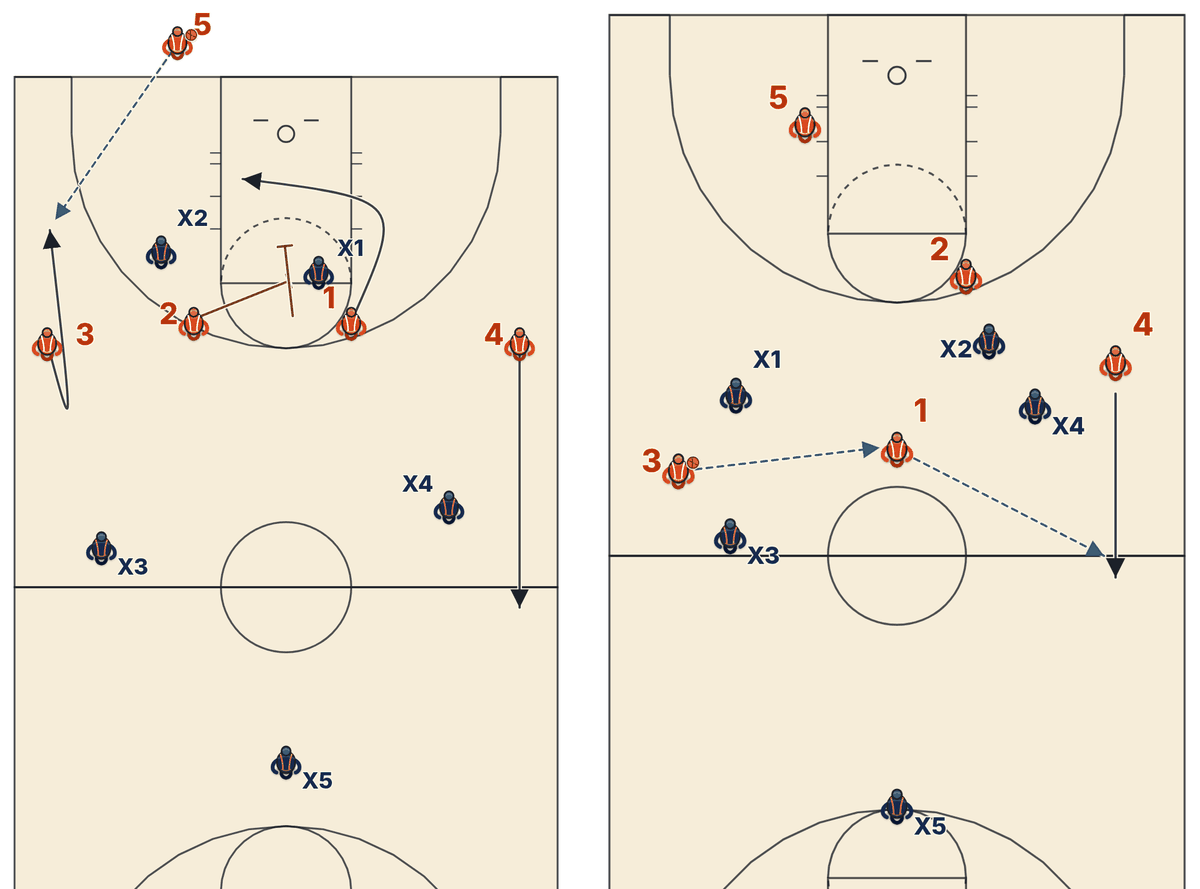 Left: 2 screens for 1 while 3 returns to receive the entry. 4 runs up the floor on the opposite side. Right: read inside the trap. The middle receiver can advance the ball to the opposite side.
If the first middle target is covered, the guard clears up the ball-side sideline and the screener replaces him in the middle. The inbounder stays behind as the reversal. The rule from the book is one sentence: keep one teammate where the trapped player can see him.
When the 2-2-1 Drops to Half Court
Some teams pull the 2-2-1 back and trap at half court. My practice menu uses a two-guard alignment against a half-court 2-2-1, with one rule before the entry. Pass across half court rather than dribble across into the trap. The half-court line works like a second sideline, and a guard who dribbles into that corner has given the defense two boundaries.
Against the half-court 2-2-1, put a middle receiver between the second-line defenders and let the corners stretch the back line. A tall middle target can help a smaller guard, but he still has to be in a clear passing lane.
The Bench Card
The book ends with printable bench cards. The 2-2-1 card reads like this:
- Look: Two high, two behind, one deep. Watch the sideline trap.
- First entry: Four across with 2 screening for 1 and 3 coming back along the side.
- Middle read: As 3 is trapped, find 1 inside.
- Middle denied: 1 clears up the side and 2 replaces in the middle.
- Safety: 5 stays behind the ball.
- Half court: Coach DeForest’s two-guard call passes across half court.
How to Practice It
Use the progression drill from the book, and spend extra time on the 5-on-2 step. Two defenders trap the first catch, and the ball has to get out before the trap closes. The goal for that step is four words: pass, don’t dribble, out of the trap. Then go 5 on 4 with the press you will see next and no one deep, so your players learn to score when the long pass is there.
For the full progression and the man to man entries, read Press Break Basketball.
Frequently Asked Questions
What is the weakness of a 2-2-1 press? The middle. Once the first pass is made and the ball reaches a receiver between the second-line defenders, the trap is beaten and only one defender is deep.
What alignment beats a 2-2-1 press? Four across at free-throw line extended, often called a 1-4. It gives you a sideline, a middle cutter and runners up both sides.
Should you dribble against a 2-2-1? Read the second line first. The 2-2-1 wants you to dribble toward the sideline, where the trap is waiting. Pass ahead before the trap closes.
How do you beat a half-court 2-2-1 trap? Use two guards and pass across half court rather than dribbling across into the trap. Put a receiver between the second-line defenders.
Every entry, counter and bench card is in The Complete Guide to Breaking the Press, on Kindle and in paperback.